Solar Panel Scheme 2026 Required Documents
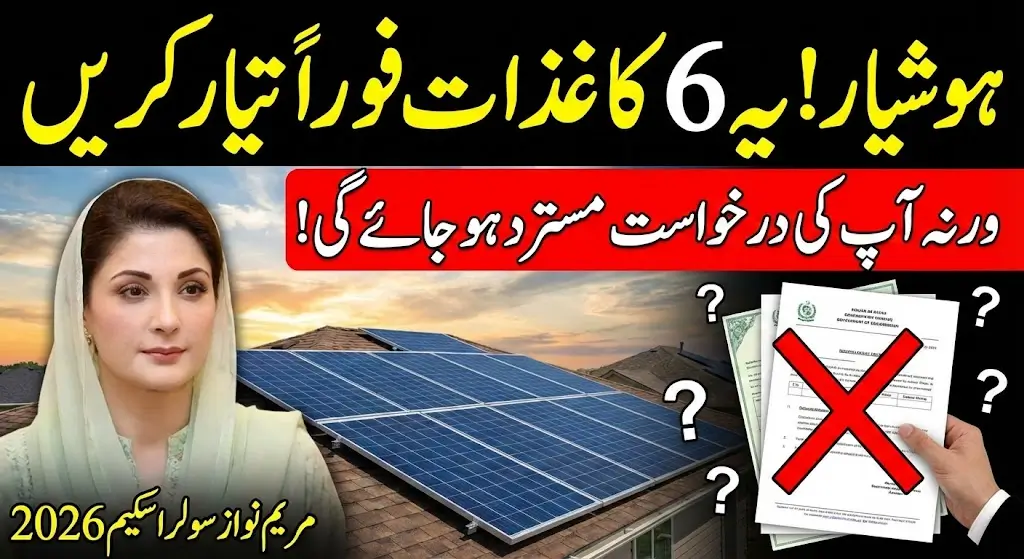
Solar Panel Scheme 2026 Required Documents: Maryam Nawaz Solar Panel Scheme 2026 is a major welfare initiative launched by the Punjab Government to support low- and middle-income households struggling with rising electricity costs. Before applying, it is essential for applicants to clearly understand the required documents and eligibility conditions, as these two factors determine whether an application is accepted or rejected.
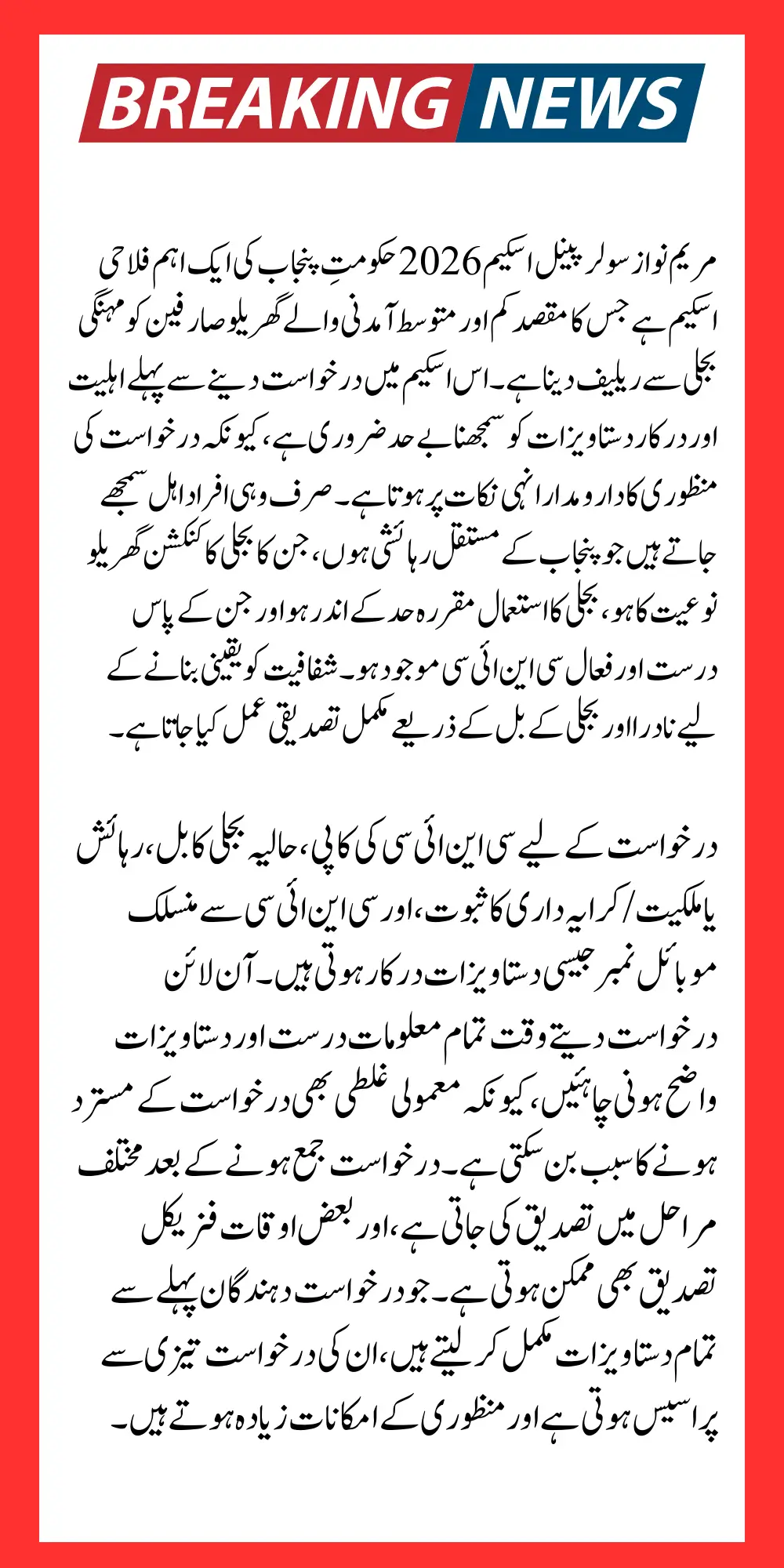
This scheme follows a structured and transparent verification process. Only applicants who provide complete and authentic documentation and meet the eligibility standards can move forward. Understanding these requirements in advance not only saves time but also builds applicant confidence and trust in the government’s digital application system.
You Can Also Read: CM Punjab Solar Panel Scheme Online Apply 2026
| Category | Details |
|---|---|
| Applicant Eligibility | Permanent resident of Punjab with domestic electricity connection |
| Electricity Usage | Monthly consumption within approved government limit |
| CNIC Requirement | Valid and NADRA-verified CNIC |
| Required Documents | CNIC copy, recent electricity bill, residence proof |
| Application Method | Online submission through official portal |
| Verification Process | CNIC, electricity bill, and residential verification |
Eligibility Overview for Solar Panel Scheme 2026
To ensure fair distribution, the Punjab Government has introduced a document-based verification mechanism. These documents confirm identity, residence, electricity usage, and financial status. Applicants must upload clear and valid copies through the official portal to avoid delays or disqualification.
Eligibility is closely linked with electricity consumption patterns and residential status. The scheme mainly targets households that consume limited electricity and do not already benefit from large-scale solar installations. This approach ensures that relief reaches deserving families instead of commercial users.
Eligibility Criteria for Maryam Nawaz Solar Panel Scheme 2026
The eligibility criteria have been designed to prioritize households that genuinely need relief from high electricity bills. Applicants must meet basic residential and consumption-related requirements to qualify for the scheme.
From a policy perspective, the government aims to support domestic electricity users rather than businesses or industrial consumers. Therefore, applicants must ensure their electricity connection is registered for residential use and falls within the approved consumption bracket.
Key Eligibility Requirements
- Applicant must be a permanent resident of Punjab
- Electricity connection must be domestic, not commercial
- Monthly electricity consumption should fall within the approved limit set by the government
- Applicant should not already own a government-subsidized solar system
- CNIC must be valid and registered with NADRA
- Electricity meter must be registered in the applicant’s name or an immediate family member’s name
You Can Also Read: Check Eligibility For Free Solar Plate
Required Documents for Maryam Nawaz Solar Panel Application
Submitting accurate documents is one of the most critical steps in the application process. Each document plays a specific role in verifying the applicant’s identity, location, and electricity usage. Any mismatch or missing document may lead to application rejection.
Applicants should prepare all documents in advance and ensure that scanned copies are clear, readable, and up to date. Using authentic documents not only speeds up verification but also strengthens the credibility of the application during the screening process.
List of Required Documents for Solar Panel Scheme 2026
- Copy of applicant’s CNIC (front and back)
- Recent electricity bill showing meter number and consumption details
- Proof of residence (utility bill or domicile, if required)
- Ownership or tenancy proof of the house
- Registered mobile number linked with CNIC
- Passport-size photograph (digital format)
CNIC Verification and NADRA Record Importance
CNIC verification is the backbone of the Maryam Nawaz Solar Panel Scheme 2026. The applicant’s CNIC is cross-checked with NADRA records to confirm identity, family data, and residential status. Any inconsistency in CNIC information can result in automatic rejection.
Applicants must ensure their CNIC is active and not expired. If the CNIC address differs from the current residence, it is recommended to update NADRA records before applying. This step increases approval chances and avoids unnecessary complications during verification
Electricity Bill Requirements and Consumption Criteria
The electricity bill is used to assess eligibility based on consumption levels and meter ownership. It helps authorities determine whether the applicant fits within the target group of low to moderate electricity users.
The bill must be recent and clearly display the meter number, customer name, and monthly units consumed. Bills with unclear data or unpaid dues may delay processing. Applicants are advised to clear outstanding dues before submission to ensure smooth approval.
Electricity Bill Conditions to Fulfill
- Bill should be issued within the last 1–2 months
- Meter must be registered as domestic
- Applicant name or close family member name should appear on the bill
- Consumption should remain within the scheme’s defined threshold
Residential Status and Property Verification
Residential verification ensures that solar panels are installed at genuine household locations rather than vacant or commercial properties. This step helps prevent misuse of government resources and ensures proper installation planning.
Applicants living in rented houses may still be eligible, but they must provide tenancy proof or owner consent where required. The property should have sufficient rooftop space for solar panel installation, as technical feasibility is also assessed later.
Online Application Submission Guidelines
The application process for the Maryam Nawaz Solar Panel Scheme 2026 is fully digital to ensure transparency and efficiency. Applicants must carefully fill out the online form and upload documents in the correct format.
Errors such as incorrect CNIC numbers, mismatched meter details, or blurry document uploads are common reasons for rejection. Reviewing all information before final submission significantly improves approval chances.
Important Online Submission Tips
- Use a registered mobile number for OTP verification
- Upload documents in clear image or PDF format
- Double-check CNIC and meter numbers before submission
- Keep a screenshot or reference number after applying
Verification Process After Application Submission
Once the application is submitted, it goes through multiple verification stages. These include CNIC verification, electricity usage assessment, and residential validation. This layered process ensures that only eligible applicants receive benefits.
In some cases, physical verification or follow-up communication may be conducted. Applicants should keep their phone active and respond promptly to any official message or call to avoid delays.
Common Reasons for Application Rejection
Understanding rejection reasons helps applicants avoid common mistakes. Many applications are rejected due to simple errors that can be easily prevented with careful preparation.
Incomplete documentation, incorrect information, or ineligible electricity consumption are among the most frequent issues. Reviewing eligibility and document requirements beforehand is the best way to ensure success.
Common Mistakes to Avoid
- Uploading expired CNIC
- Providing incorrect meter details
- Applying with commercial electricity connection
- Submitting unclear or cropped documents
Benefits of Preparing Documents in Advance
Preparing documents before applying saves time and reduces stress. It also allows applicants to identify and correct any issues in advance, such as expired CNICs or unpaid electricity bills. Well-prepared applications move faster through the verification process and have a higher chance of approval. This proactive approach reflects seriousness and compliance with government guidelines.
Conclusion
Maryam Nawaz Solar Panel Scheme 2026 is a well-structured initiative aimed at providing long-term energy relief to deserving households. Understanding required documents and eligibility criteria is the foundation of a successful application.
Applicants who carefully follow guidelines, submit accurate documents, and meet eligibility standards significantly increase their chances of approval. With proper preparation and attention to detail, this scheme can become a valuable step toward sustainable and affordable energy for Punjab’s households.